Fact sheet
- Latin name
- Boötes (Boo)
- Brightest star
- Arcturus (α Boo)
- Relative brightness
- -0.04 mag
- Hipparcos catalogue
- HIP 69673
- Area
- 907 deg² (rank: 13 out of 88)
- Right ascension
- 13h 35m 49s to 15h 49m 28s
- Declination
- +7° 21' 38'' to +55° 02' 42''
- Neighbouring constellations
- Draco, Ursa Major, Canes Venatici, Coma Berenices, Virgo, Serpens Caput, Corona Borealis, Hercules
Visibility
The constellation Boötes
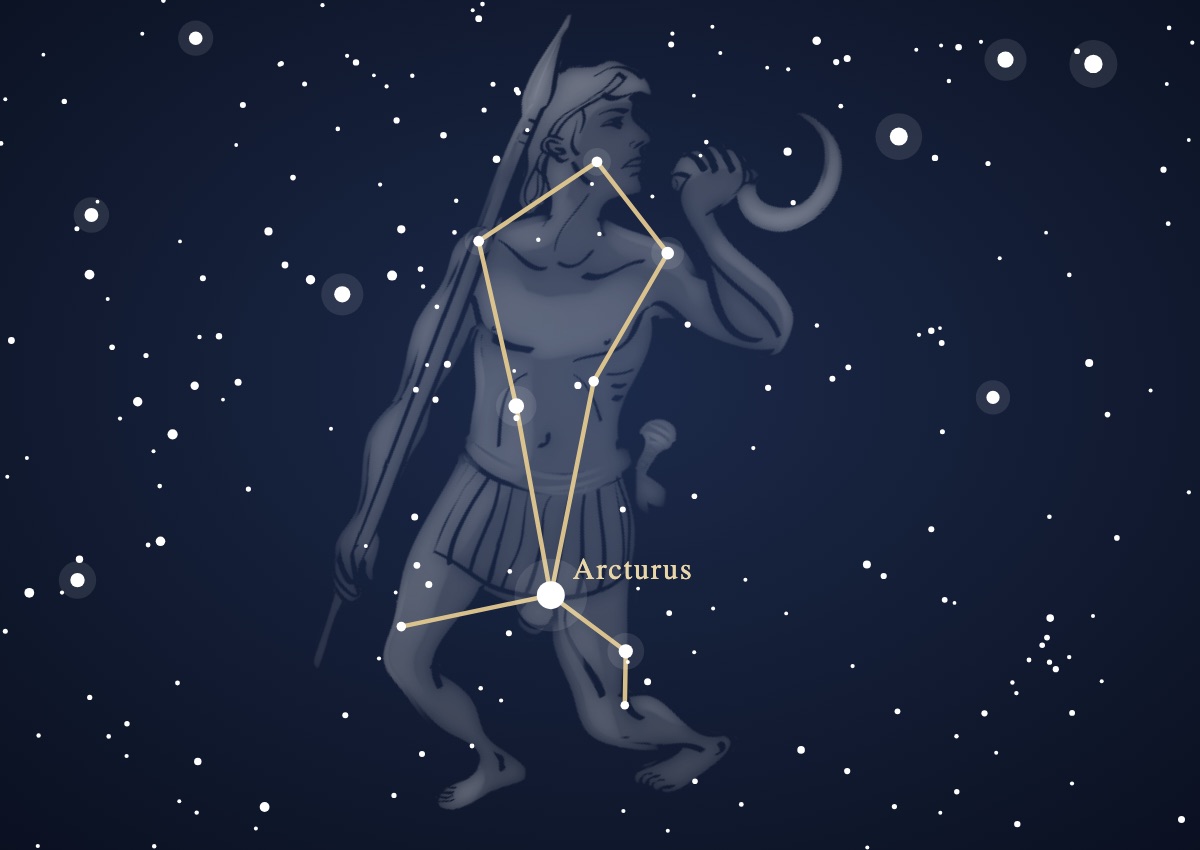
Boötes is a constellation of the northern hemisphere. Its brightest star α Bootis bears the Greek name Arcturus (bear keeper). It is the brightest star of the northern sky and the fourth brightest star in the entire sky. In the north of Boötes, towards Draco, there used to be the constellation Quadrans Muralis (the mural quadrant, introduced by Lalande in 1795). The Quadrantids, a meteor shower in early January, are still named after it today.
Boötes is also called the herdsman or the ox driver; the Greek name Boötes itself means “ox driver”. The ancient Romans, too, saw seven plough oxen in the seven stars of the Big Dipper in the constellation Ursa Major, and their driver in the neighbouring constellation. The English still see a plough in the Big Dipper today and the ploughman beside it. For this constellation, however, the view of the ancient Greeks has prevailed: they simply saw the hindquarters of the bear in the seven stars and the bear keeper in the neighbouring constellation.
Mythology
According to Greek mythology, Boötes represents Icarius, the founder of winegrowing. He was taught this knowledge by Dionysus, the god of wine, in person. On one of his journeys, Dionysus stopped at the house of Icarius. He politely declined the goat's milk he was offered and instead let Icarius taste the wine that he had grown himself. Because Icarius was a gifted gardener, Dionysus decided to teach him the art of growing grapes and making wine. Afterwards, Icarius travelled through the country with his dog Maera to make the drink known to the people. On the way they met a group of shepherds, and Icarius kindly offered them some of his drink. The shepherds were not used to the alcohol and quickly became drunk and unconscious. Their companions believed they had been poisoned, killed Icarius and buried him under a tree. His dog Maera ran home whimpering to Erigone, the daughter of Icarius, and led her to her father's grave. In her despair, Erigone took her own life, and Maera also died of grief. An alternative legend is similar to the mythology of the constellation Ursa Major. Zeus, the father of the gods, made Callisto pregnant, and she gave birth to their son Arcas. Hera, the jealous wife of Zeus, then turned Callisto into a bear. When Callisto later met Arcas, who had meanwhile grown up to be a hunter, Zeus prevented Arcas at the last second from killing his mother in the shape of a bear. Callisto was placed in the sky as the constellation Ursa Major, and her son Arcas was immortalised, depending on the version of the myth, either as Ursa Minor or as Boötes.