Fact sheet
- Latin name
- Norma (Nor)
- Brightest star
- γ² Normae (γ² Nor)
- Relative brightness
- 4.02 mag
- Hipparcos catalogue
- HIP 80000
- Area
- 165 deg² (rank: 74 out of 88)
- Right ascension
- 15h 12m 14s to 16h 36m 08s
- Declination
- -60° 26' 08'' to -42° 16' 03''
- Neighbouring constellations
- Scorpius, Lupus, Circinus, Triangulum Australe, Ara
Visibility
The constellation Norma
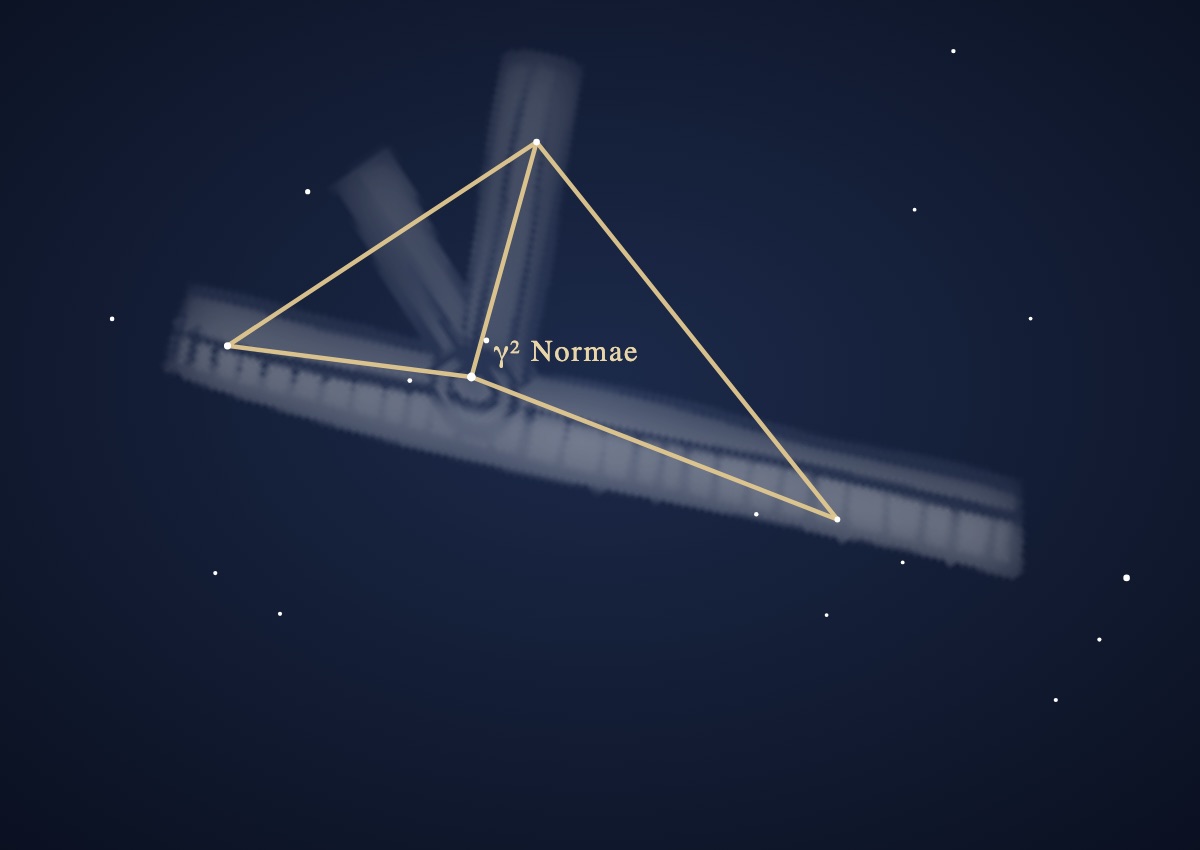
Norma is a constellation of the southern hemisphere. Its brightest star is γ² Normae. The constellation has no stars with the designations alpha (α) and beta (β), because these stars were assigned to the constellation Scorpius in the 19th century. Today these stars are called N Scorpii and H Scorpii. The constellation Norma lies west of Scorpius and east of Centaurus. Hidden behind the Milky Way here is the Norma Cluster of galaxies, some 220 million light years away. It lies at the centre of the “Great Attractor”, a huge concentration of mass that is pulling on our Milky Way.
History
The French theologian Nicolas-Louis de Lacaille, who devoted his life to astronomy, geodesy and mathematics, introduced 14 new constellations of the southern hemisphere. In 1750, he set off on a four-year journey to the Cape of Good Hope in order to observe, among other things, the constellations of the southern sky. During this time, he catalogued almost 10,000 stars. Nicolas-Louis de Lacaille named most of his new constellations after technical instruments. In this way, the constellations Sculptor, Fornax, Caelum, Antlia, Pictor, Microscopium, Reticulum, Octans, Horologium, Pyxis, Mensa, Telescopium, Norma and Circinus came into being. He also divided the large ancient constellation Argo Navis into the three constellations Carina, Puppis and Vela. His star catalogue of the southern sky was published in 1763, one year after his death, under the title “Coelum Australe Stelliferum”. What his 14 new constellations have in common is that they consist of relatively faint stars.
Nicolas-Louis de Lacaille formed the constellation Norma from stars that originally belonged to the constellations Lupus and Ara. He named it "Norma et Regula". It represents a set square and a ruler. At that time, these tools were used by draughtsmen, surveyors and craftsmen. The name of the constellation was later shortened to "Norma".