Fact sheet
- Latin name
- Dorado (Dor)
- Brightest star
- α Doradus (α Dor)
- Relative brightness
- 3.27 mag
- Hipparcos catalogue
- HIP 21281
- Area
- 179 deg² (rank: 72 out of 88)
- Right ascension
- 3h 53m 17s to 6h 35m 45s
- Declination
- -70° 06' 15'' to -48° 40' 12''
- Neighbouring constellations
- Caelum, Horologium, Reticulum, Hydrus, Mensa, Volans, Pictor
Visibility
The constellation Dorado
Dorado is a constellation of the southern hemisphere. It is partly circumpolar around the South Pole. This means that some of its stars are so close to the celestial pole that they never set as seen from Sydney. Part of the constellation is therefore above the horizon all year round there.
Although the stars of the constellation Dorado are difficult to see in the sky, the constellation has a lot to offer sky watchers with the Large Magellanic Cloud (LMC). It was named after the Portuguese navigator Ferdinand Magellan, because it became known in Europe through his voyage around the world. It is a separate galaxy with many billions of stars at a distance of around 160,000 light years, and it can be seen with the naked eye. At the north-eastern end of the Large Magellanic Cloud (LMC) lies the famous Tarantula Nebula (NGC 2070), a huge region where stars are formed, which looks like a tarantula because of its spider-like structure. The Tarantula Nebula can also be seen with the naked eye. It is also known by the name 30 Doradus, because it was once thought to be a single star. Near it, in February 1987, the supernova SN 1987A flared up, the first supernova visible to the naked eye since 1604.
Thanks to the Large Magellanic Cloud (LMC), the constellation Dorado is easy to find in the sky despite its faint stars. The star Canopus in the constellation Carina gives further help. It is the second brightest star in the sky and lies north-east of the constellation Dorado.
History
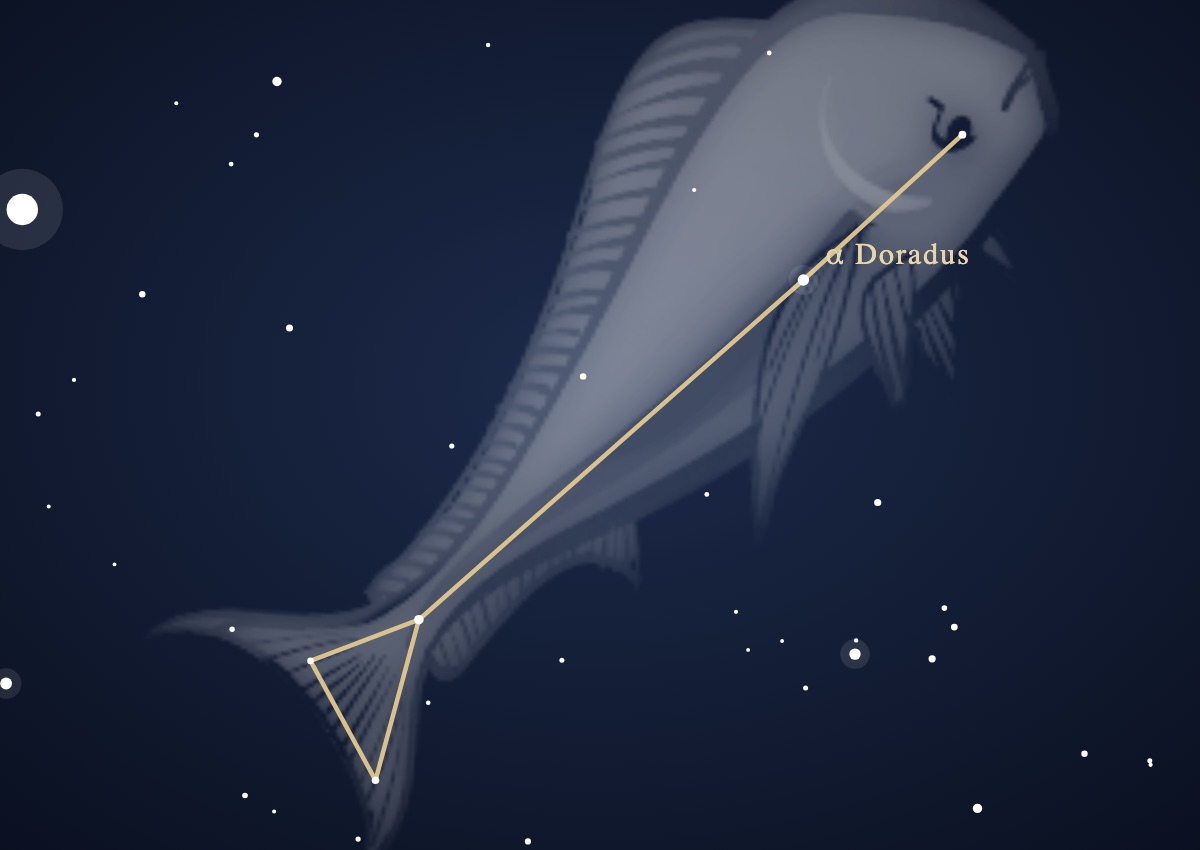
The constellation first appears in 1598 on the celestial globe of Petrus Plancius under the Spanish name Dorado. Dorado actually means “dolphinfish” (Coryphaena hippurus), a food fish of tropical and subtropical waters. Petrus Plancius knew this fish and the group of stars from the records of the two Dutch seafarers Pieter Dirkszoon Keyser and Frederick de Houtman. In 1603, the German astronomer Johannes Bayer included the constellation in his star atlas under the name Dorado. Johannes Kepler called it Xiphias (Swordfish) in the Rudolphine Tables in 1627. This name was later also used by Halley, Hevelius and Johann Elert Bode in his Uranographia (1801). In German the name Schwertfisch (Swordfish) has remained, while internationally the name Dorado is used. The frequently seen translation “goldfish” is misleading, because what is meant is the dolphinfish.