Fact sheet
- Latin name
- Triangulum Australe (TrA)
- Brightest star
- Atria (α TrA)
- Relative brightness
- 1.91 mag
- Hipparcos catalogue
- HIP 82273
- Area
- 110 deg² (rank: 83 out of 88)
- Right ascension
- 14h 56m 01s to 17h 13m 53s
- Declination
- -70° 30' 42'' to -60° 15' 52''
- Neighbouring constellations
- Norma, Circinus, Apus, Ara
Visibility
The constellation Triangulum Australe
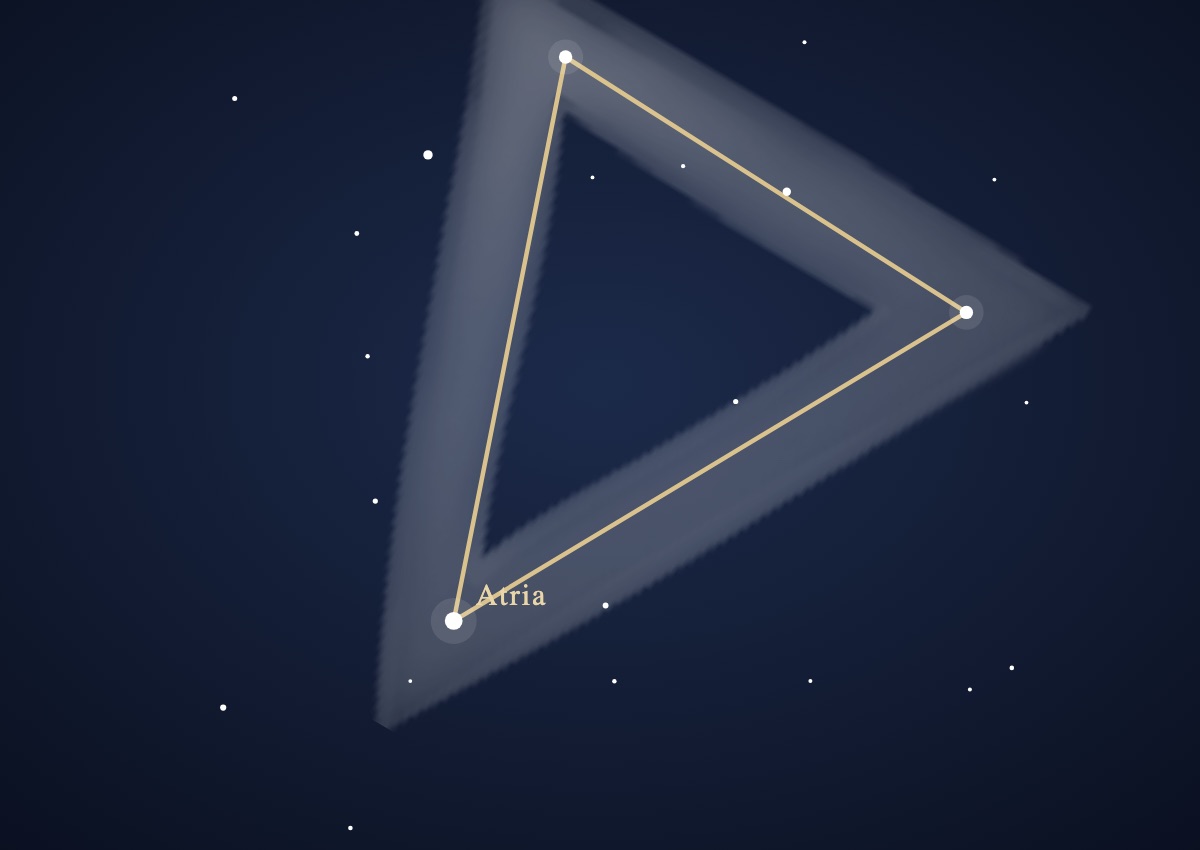
Triangulum Australe is a constellation of the southern hemisphere. Its brightest star is α Trianguli Australis, also called Atria, an invented word formed from the Latin designation “Alpha Trianguli Australis”. The names of the second and third brightest stars came about in the same way: Beta Trianguli Australis is also called Betria, and Gamma Trianguli Australis Gatria.
Triangulum Australe is much brighter, but somewhat smaller than its northern counterpart, the constellation Triangulum. Atria, Betria and Gatria form an isosceles triangle. As stars of the 2nd and 3rd magnitude, they are easy to see with the naked eye. The easiest way to find the constellation is with the help of Rigil Kentaurus, the brightest star of Centaurus and the third brightest star in the sky: Triangulum Australe lies to the east of it.
History
While the constellations of the northern hemisphere had already been known since ancient times and are based on a great variety of myths, many constellations of the southern hemisphere remained without names for a long time. Only in the 16th century did people turn their attention to them. Between 1595 and 1597, the Dutch seafarers Pieter Dirkszoon Keyser (chief navigator) and Frederick de Houtman (the captain's brother) mapped the southern sky on an expedition on behalf of Petrus Plancius. Influenced by their experiences on their voyage to the East Indies, they named a dozen constellations: Chamaeleon, Musca, Volans, Indus, Grus, Apus, Pavo, Phoenix, Dorado, Hydrus, Triangulum Australe and Tucana. The Italian navigator Amerigo Vespucci first reported a striking triangle in 1503, but at that time it was not included in any star atlas. Almost a century later, Keyser and de Houtman sketched it for the first time while they were exploring the East Indies. The Dutch astronomer Petrus Plancius had already drawn a triangle on a celestial globe in 1589, but in the wrong place. Based on the observations of the two seafarers, he included the constellation in corrected form on his celestial globe in 1598, but chose different stars for it than they did. In 1603, the German astronomer Johannes Bayer included the constellation in his star atlas “Uranometria” for the first time with its present name “Triangulum Australe”. Later, the French astronomer Nicolas-Louis de Lacaille (1713–1762) renamed it “Libella” (a plumb level, an early form of the spirit level) for a short time, but this name did not become established.