Fact sheet
- Latin name
- Canis Major (CMa)
- Brightest star
- Sirius (α CMa)
- Relative brightness
- -1.44 mag
- Hipparcos catalogue
- HIP 32349
- Area
- 380 deg² (rank: 43 out of 88)
- Right ascension
- 6h 11m 36s to 7h 27m 54s
- Declination
- -33° 15' 02'' to -11° 01' 49''
- Neighbouring constellations
- Monoceros, Lepus, Columba, Puppis
Visibility
The constellation Canis Major
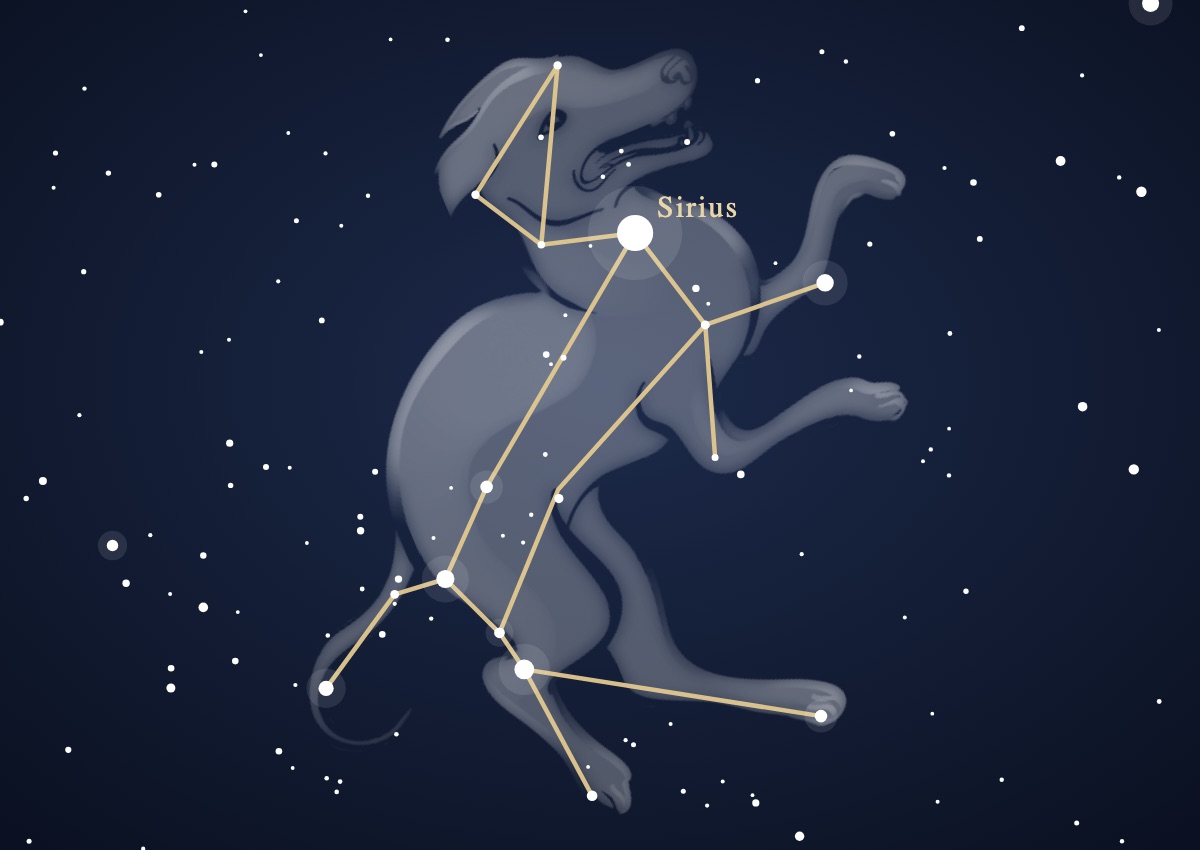
The constellation Canis Major is a constellation of the southern hemisphere. Its chest is crowned by the brightest star in the sky, α Canis Majoris, in Greek Sirius (the scorching one). In the sky, only the sun, the moon and some of the planets appear brighter.
Canis Major is easy to find: the three bright stars of the belt of Orion point in a south-easterly direction straight at Sirius.
Mythology
Since ancient times, Canis Major has had a special, although different, meaning. The Egyptians worshipped Sirius as the goddess Sopdet (Sothis in Greek), who merged with Isis. As far as we know today, they did not see a dog in these stars; it was only the Greeks and Romans who turned them into the Great Dog. In July, Sopdet announced with the rising of Sirius the yearly flooding of the Nile and therefore the end of a long drought. For the Greeks, on the other hand, the rising of Sirius marked the beginning of the great summer heat, in which the land dried up. The Romans called these hottest days of the year the “dog days”, after the dog star. Today, because of the precession of the Earth's axis, Sirius does not rise at our latitudes until the end of August, in the morning twilight; in the evening sky it can be seen mainly in the winter months.
Canis Major also appears in other Greek legends, such as the well-known one of Zeus and Europa. Zeus had fallen in love with Europa, the daughter of King Agenor of Phoenicia. He took the form of a bull with beautiful white fur and shining horns and mingled with her father's herd. Delighted, Europa decorated the bull with flowers and even sat on its back. Zeus ran to the sea and swam with her to Crete. Only there did he reveal his true form to the frightened Europa and courted her with countless gifts, among them the endlessly fast and immortal dog Laelaps. Europa passed him on to her son, who gave him to the huntress Procris. When her husband Cephalus accidentally killed her during a hunt, Laelaps became his property. Cephalus took him to Thebes, where a greedy fox that nobody could catch was causing harm. So the dog from which nothing could escape hunted the fox that could not be caught, and again and again the fox escaped him at the last second. In the end, Zeus took pity, turned both animals to stone and placed Laelaps in the sky as the constellation Canis Major.