Fact sheet
- Latin name
- Delphinus (Del)
- Brightest star
- Rotanev (β Del)
- Relative brightness
- 3.62 mag
- Hipparcos catalogue
- HIP 101769
- Area
- 189 deg² (rank: 69 out of 88)
- Right ascension
- 20h 14m 14s to 21h 09m 00s
- Declination
- +2° 24' 08'' to +20° 56' 24''
- Neighbouring constellations
- Vulpecula, Sagitta, Aquila, Aquarius, Equuleus, Pegasus
Visibility
The constellation Delphinus
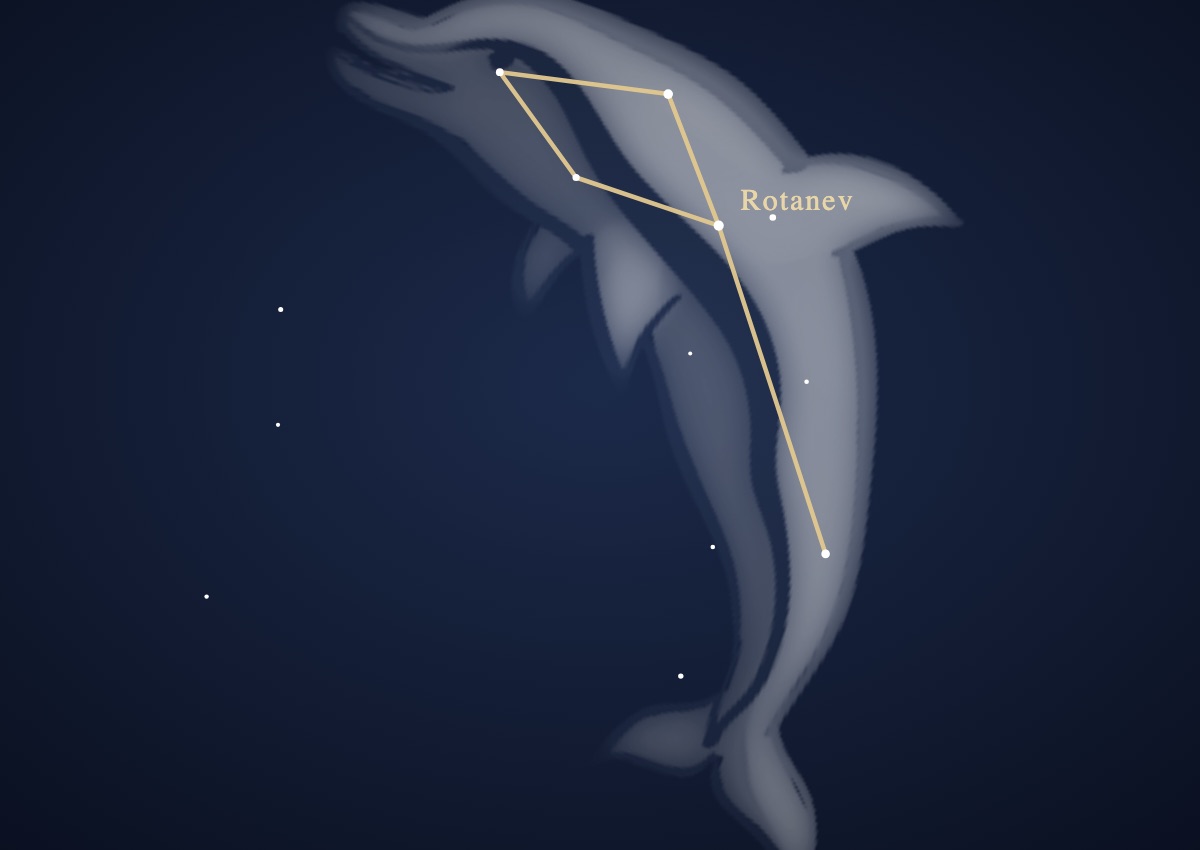
Delphinus is a constellation of the northern hemisphere. Its brightest star is β Delphini, also called Rotanev; its second brightest, α Delphini, is called Sualocin. They are among the few stars whose names are not Arabic, Latin or Greek. The Italian astronomer Niccolò Cacciatore, assistant to and successor of the great Giuseppe Piazzi at the Palermo Observatory, made a little joke when he named them in 1814: read backwards, they give Nicolaus Venator, the Latin form of his own name.
Mythology
The constellation Delphinus is linked to two legends. According to the first legend, the brothers Zeus, Poseidon and Hades divided the sky, the sea and the underworld among themselves after they had overthrown their father Cronus. Poseidon, who received the sea, built himself a huge palace in the water off the island of Euboea. But he still had no bride. So he courted the Nereid Amphitrite, one of the fifty daughters of the water god Nereus. However, she rejected him and fled to the giant Atlas. Poseidon sent out several messengers to look for her, among them a dolphin. The dolphin succeeded in finding Amphitrite and changing her mind with its calming manner. On its back she returned to Euboea and became Poseidon's wife. Full of gratitude, Poseidon placed the dolphin in the sky.
The second legend is about Arion of Lesbos, a great Greek singer and poet from the 7th century BC. He is regarded as the inventor of the cyclic choruses and as a pioneer of Greek theatre. He spent most of his life at the court of the tyrant Periander of Corinth. Arion was known throughout Greece, because nobody could play the lyre as well as he could. To increase his fame even further, he made a concert tour to Sicily, which brought him great riches. On his journey home, sailors who wanted his wealth surrounded him with swords and gave him a choice: either he would jump overboard of his own free will, or they would kill him. In this hopeless situation, Arion asked to be allowed to sing one last song. Attracted by his singing, a group of dolphins gathered around the ship. Arion, who put all his trust in the gods, threw himself into the waves to join them. And indeed, one of the dolphins took him on its back and carried him back to Greece. The sailors were later caught and sentenced to death. Apollo, the god of music and poetry, placed the dolphin and the lyre in the sky as constellations.