Fact sheet
- Latin name
- Tucana (Tuc)
- Brightest star
- α Tucanae (α Tuc)
- Relative brightness
- 2.86 mag
- Hipparcos catalogue
- HIP 110130
- Area
- 295 deg² (rank: 48 out of 88)
- Right ascension
- 22h 08m 27s to 1h 24m 49s
- Declination
- -75° 20' 50'' to -56° 18' 46''
- Neighbouring constellations
- Phoenix, Grus, Indus, Octans, Hydrus, Eridanus
Visibility
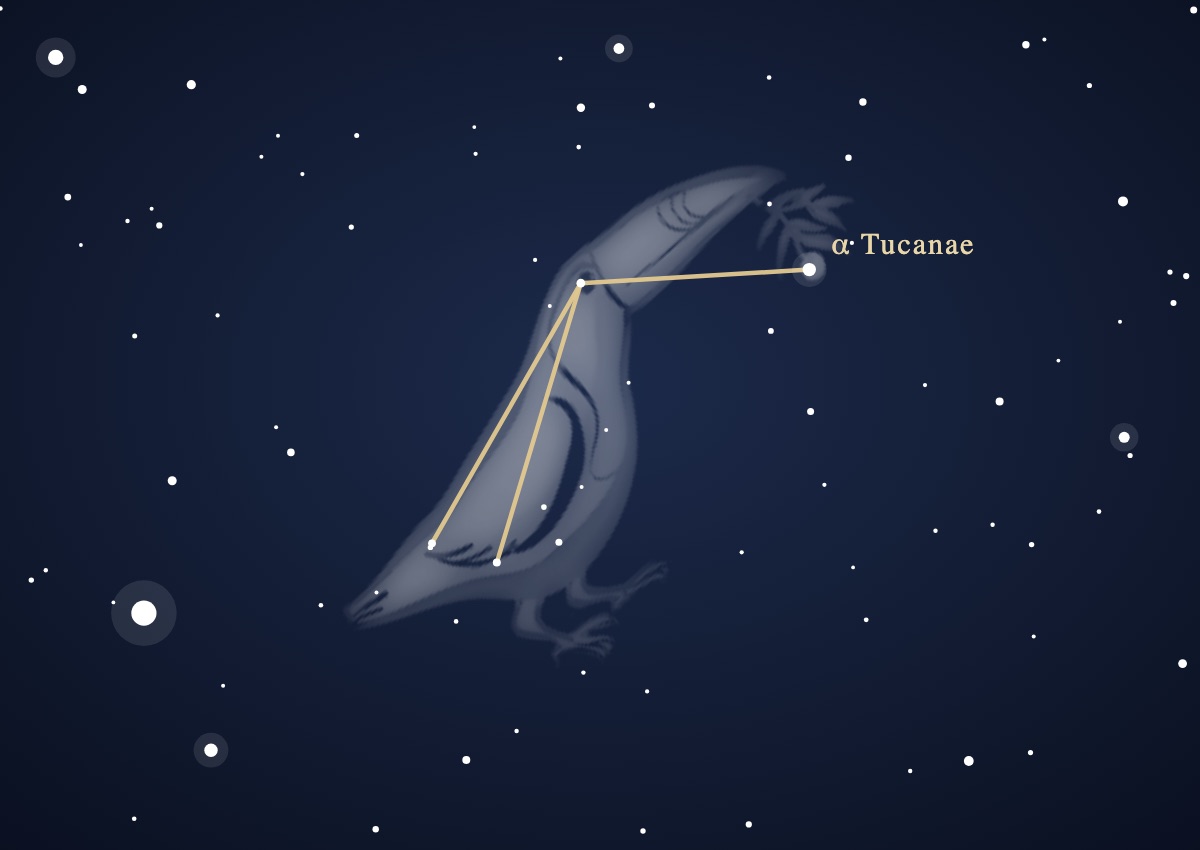
The constellation Tucana
Tucana is a constellation of the southern hemisphere. It is circumpolar around the South Pole. This means that its stars are so close to the celestial pole that they never set as seen from Sydney. The constellation is therefore above the horizon all year round there. Tucana is the least noticeable bird in the sky. Apart from its brightest star, all its stars are of the fourth magnitude or fainter and are difficult to see in the sky. However, the constellation contains two special objects that can be seen with the naked eye under ideal conditions: the Small Magellanic Cloud (NGC 292) and the second brightest globular cluster in the sky, NGC 104. The Small Magellanic Cloud was named after the Portuguese circumnavigator Ferdinand Magellan, through whose voyage around the world it became known in Europe. It is a satellite galaxy of our Milky Way, an irregular dwarf galaxy. The globular cluster NGC 104 (a spherical group of around one million stars) shines so brightly that it was originally thought to be a star and was therefore named 47 Tucanae; it is still known by this name today. Among stargazers, it is considered the most beautiful star cluster of the southern sky. In an eight-inch reflecting telescope, it appears almost as large as the moon.
History
While the constellations of the northern hemisphere had already been known since ancient times and are based on a great variety of myths, many constellations of the southern hemisphere remained without names for a long time. Only in the 16th century did people turn their attention to them. Between 1595 and 1597, the Dutch seafarers Pieter Dirkszoon Keyser (chief navigator) and Frederick de Houtman (the captain's brother) mapped the southern sky on an expedition on behalf of Petrus Plancius. Influenced by their experiences on their voyage to the East Indies, they named a dozen constellations: Chamaeleon, Musca, Volans, Indus, Grus, Apus, Pavo, Phoenix, Dorado, Hydrus, Triangulum Australe and Tucana. Frederick de Houtman listed the constellation in his star catalogue of 1603 as “Den Indiaenschen Exster, op Indies Lang ghenaemt” (Indian magpie), which probably referred to a hornbill. Johannes Kepler (1571–1630) later called it Anser Americanus (American goose), but this name did not become established either. Tucana received its final form from the Dutch astronomer Petrus Plancius (1552–1622), who had already depicted it on a celestial globe in 1598.