Fact sheet
- Latin name
- Canes Venatici (CVn)
- Brightest star
- Cor Caroli (α CVn)
- Relative brightness
- 2.84 mag
- Hipparcos catalogue
- HIP 63125
- Area
- 465 deg² (rank: 38 out of 88)
- Right ascension
- 12h 06m 22s to 14h 07m 33s
- Declination
- +27° 50' 38'' to +52° 21' 35''
- Neighbouring constellations
- Ursa Major, Coma Berenices, Boötes
Visibility
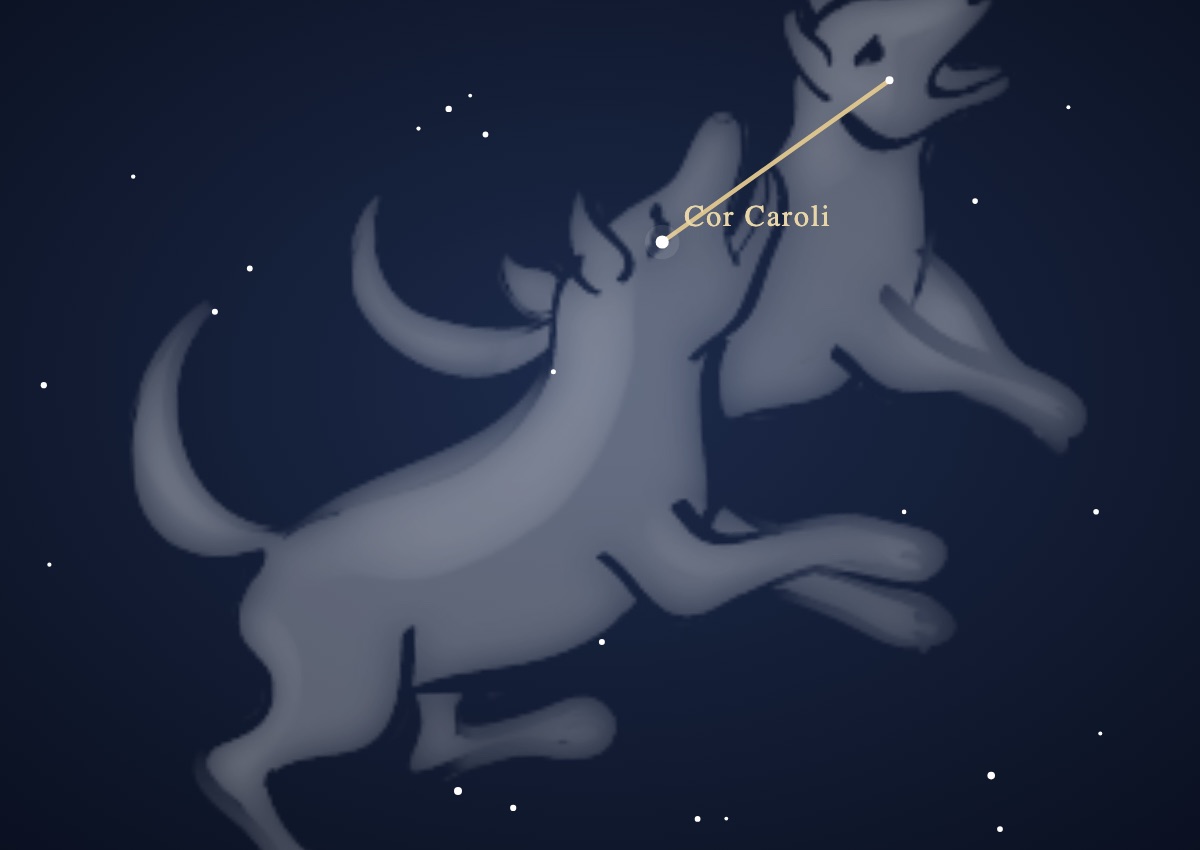
The constellation Canes Venatici
Canes Venatici is a constellation of the northern hemisphere. Its brightest star, Cor Caroli (α CVn), represents the head of the southern dog. Its second brightest star, β CVn, on the other hand, forms the head of the northern dog. The two dogs are called Asterion (Greek for “little star”) and Chara (Greek for “joy”). However, the literature does not agree on which name belongs to which dog. At the same time, both names are also given to the star β CVn. Canes Venatici lies south of the handle of the Plough. The hunting dogs are therefore snapping at the hind legs of the bear.
The spiral galaxy M 51 (NGC 5194), also known as the Whirlpool Galaxy, is easy to find even with binoculars. It was the first galaxy in which a spiral shape was discovered. The spiral galaxy lies below the tail of the constellation Ursa Major. However, it belongs to the constellation Canes Venatici and is one of the most beautiful galaxies of the northern sky.
History
The star Cor Caroli (Heart of Charles) is named after Charles I (King of England, Scotland and Ireland) and Charles II. By attempting to rule without Parliament, Charles I started the English Civil War in 1642. It ended in 1649 with his execution and the temporary abolition of the monarchy. In 1660 his son Charles II succeeded in being restored to the throne. The brightest star in the constellation Canes Venatici is said to have shone especially brightly on 29 May 1660, when Charles II returned to London for the restoration of the monarchy. In his last years, Charles II ruled without Parliament. Charles II left no legitimate descendants, but a large number of illegitimate children. Almost all of them were officially recognised by him and given noble titles. However, they had no claim to the throne. His best-known descendants of our time are probably Diana, Princess of Wales, and Queen Camilla. Because Charles II left no heir to the throne, his brother James II succeeded him. James II was the last Catholic king of England and was removed from the throne in 1688 as a result of the Glorious Revolution.
It takes a lot of imagination to see two dogs in a line between two brighter stars. In fact, this constellation goes back to an early translation error. The ancient astronomer Ptolemy originally called some of these stars the “Kollorobon” (Greek for “club”) of Boötes, the herdsman. Because an Arabic translator did not know this word, it simply became “Kullab” (hook). Another translator, who could not identify the word “Kullab”, translated it as “Kilab” (dogs). In this way the club of Boötes became the constellation Canes Venatici.