Fact sheet
- Latin name
- Cygnus (Cyg)
- Brightest star
- Deneb (α Cyg)
- Relative brightness
- 1.25 mag
- Hipparcos catalogue
- HIP 102098
- Area
- 804 deg² (rank: 16 out of 88)
- Right ascension
- 19h 07m 30s to 22h 03m 03s
- Declination
- +27° 43' 57'' to +61° 21' 28''
- Neighbouring constellations
- Cepheus, Draco, Lyra, Vulpecula, Pegasus, Lacerta
Visibility
The constellation Cygnus
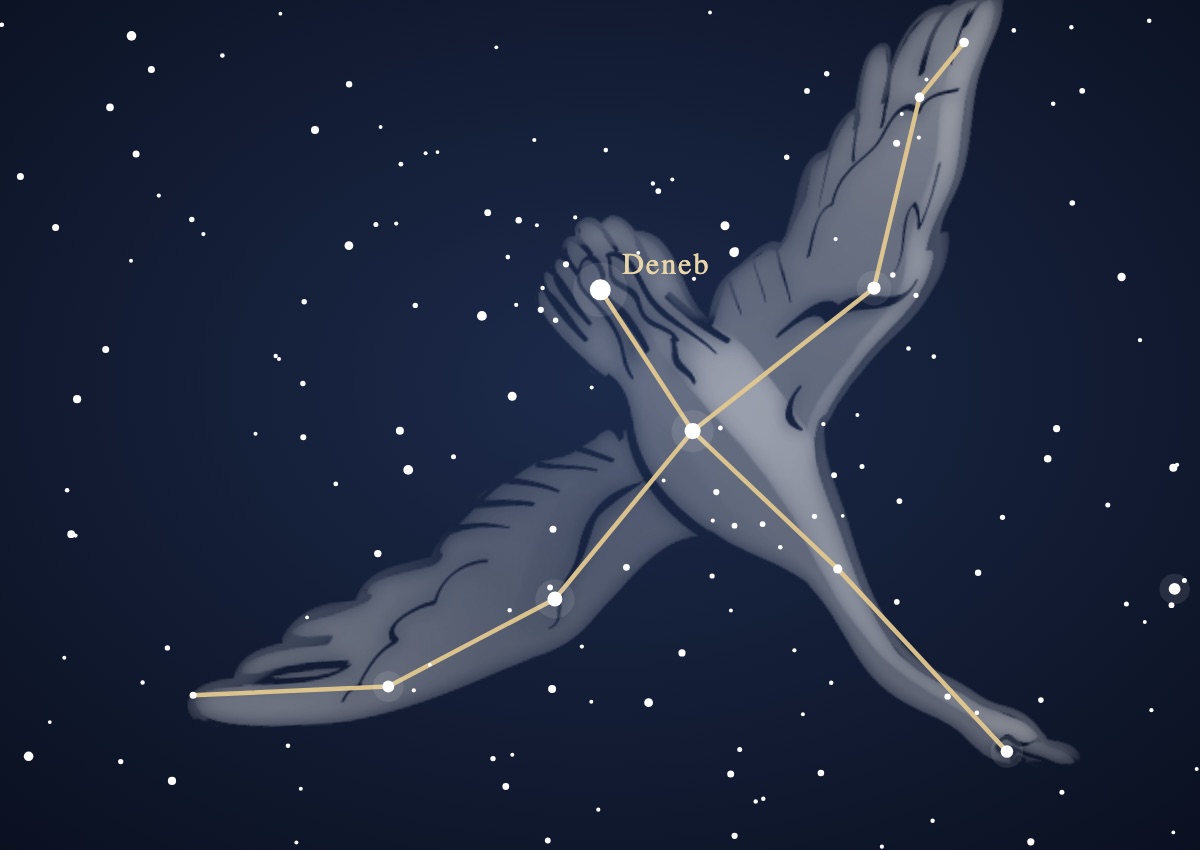
Cygnus is a constellation of the northern hemisphere. It is partly circumpolar around the North Pole. This means that some of its stars are so close to the celestial pole that they never set as seen from Berlin. Part of the constellation is therefore above the horizon all year round there. Cygnus is often also called the “Northern Cross”. Its brightest star is α Cygni, with the Arabic name Deneb (tail). Deneb belongs to the famous Summer Triangle, a simple group of stars in the northern sky, together with Vega, the brightest star of Lyra, and Altair, the brightest star of Aquila. In about 8,000 years, Deneb will be the Pole Star. At present it is Polaris in the constellation Ursa Minor. Because it lies almost exactly above the geographic North Pole, it is the only star in the northern hemisphere that always stays at the same place in the sky. However, because of the wobbling of the Earth's axis, it will not keep this special feature forever. Cygnus X-1 lies at the neck of the swan. It was the first object that astronomers classified as a black hole. With around 21 solar masses, it draws gas away from a companion star.
Mythology
In Greek legends, Zeus, the father of the gods, turns himself into a swan, among other things, in order to approach beautiful women without being recognised. One of these legends is about the twins Castor and Pollux. One day, their mother Leda, the queen of Sparta, fell for the charm of Zeus, who visited her as a swan. In the same night, however, she also slept with her husband, King Tyndareus. Leda gave birth to four children: two by Zeus, who were therefore immortal, and two by Tyndareus. Pollux was a son of Zeus, Castor a son of Tyndareus. The inseparable brothers became excellent fighters and had heroic adventures together. Castor died in a quarrel with their cousins, and Pollux then asked Zeus to let him share his immortality with his brother. From then on, they spent their days alternately in Hades, the underworld, and on Olympus, the mountain of the gods. Because of their brotherly love, both of them were placed in the sky, tightly embraced for eternity.
Another legend is about Phaethon, the son of the sun god Helios. He had borrowed his father's sun chariot, but because he drove it so recklessly, the chariot went out of control and the earth was in danger of burning. Zeus killed him just in time with a bolt of lightning, after which he fell into the river Eridanus. Phaethon's friend King Cycnus was endlessly sad about this and from then on wandered sadly along the banks of the Eridanus. In the end, the gods took pity on him and placed Cycnus in the sky in the form of the swan.