Fact sheet
- Latin name
- Hydrus (Hyi)
- Brightest star
- β Hydri (β Hyi)
- Relative brightness
- 2.80 mag
- Hipparcos catalogue
- HIP 2021
- Area
- 243 deg² (rank: 61 out of 88)
- Right ascension
- 0h 06m 08s to 4h 35m 11s
- Declination
- -82° 03' 52'' to -57° 50' 54''
- Neighbouring constellations
- Eridanus, Phoenix, Tucana, Octans, Mensa, Dorado, Reticulum, Horologium
Visibility
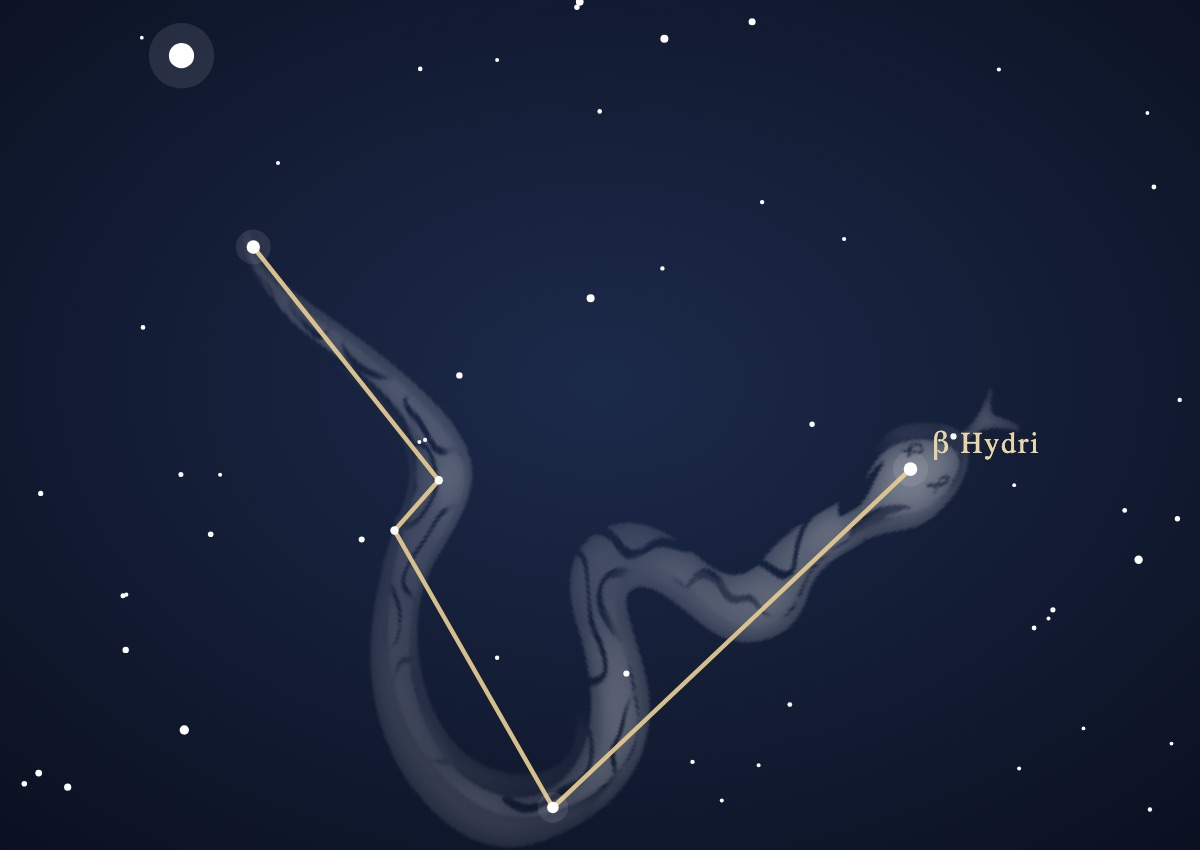
The constellation Hydrus
Hydrus is a constellation of the southern hemisphere. It is circumpolar around the South Pole. This means that its stars are so close to the celestial pole that they never set as seen from Sydney. The constellation is therefore above the horizon all year round there. The brightest star of the constellation is the star β Hydri. The head of the water snake is represented by α Hydri.
The constellation Hydrus lies near the Small Magellanic Cloud (NGC 292), which can be seen with the naked eye under ideal conditions. The Magellanic Cloud was named after the Portuguese navigator Ferdinand Magellan, because it became known in Europe through his voyage around the world. It is a companion galaxy of our Milky Way, an irregular dwarf galaxy (an extragalactic star system [a star system outside our galaxy]). Officially, however, the Small Magellanic Cloud lies in the constellation Tucana.
History
While the constellations of the northern hemisphere have been known since ancient times and are based on many different mythologies, many constellations of the southern hemisphere remained unnamed for a long time. It was not until the 16th century that people began to deal with them. Between 1595 and 1597, the Dutch seafarers Pieter Dirkszoon Keyser (chief navigator) and Frederick de Houtman (brother of the captain) mapped the southern sky on an expedition on behalf of Petrus Plancius. Influenced by their experiences on their voyage to the East Indies, they named a dozen constellations: Chamaeleon, Musca, Volans, Indus, Grus, Apus, Pavo, Phoenix, Dorado, Hydrus, Triangulum Australe and Tucana.
The constellation Hydrus is also known as the southern water snake or the male water snake. It is the southern counterpart of the constellation Hydra (the largest constellation in the sky). The name of the constellation Hydrus was finally established when the astronomer Johannes Bayer adopted the name “Hydrus” for the constellation in his celestial atlas “Uranometria” in 1603.