Fact sheet
- Latin name
- Scutum (Sct)
- Brightest star
- α Scuti (α Sct)
- Relative brightness
- 3.81 mag
- Hipparcos catalogue
- HIP 91117
- Area
- 109 deg² (rank: 84 out of 88)
- Right ascension
- 18h 21m 36s to 18h 59m 10s
- Declination
- -15° 56' 37'' to -3° 50' 01''
- Neighbouring constellations
- Serpens, Sagittarius, Aquila
Visibility
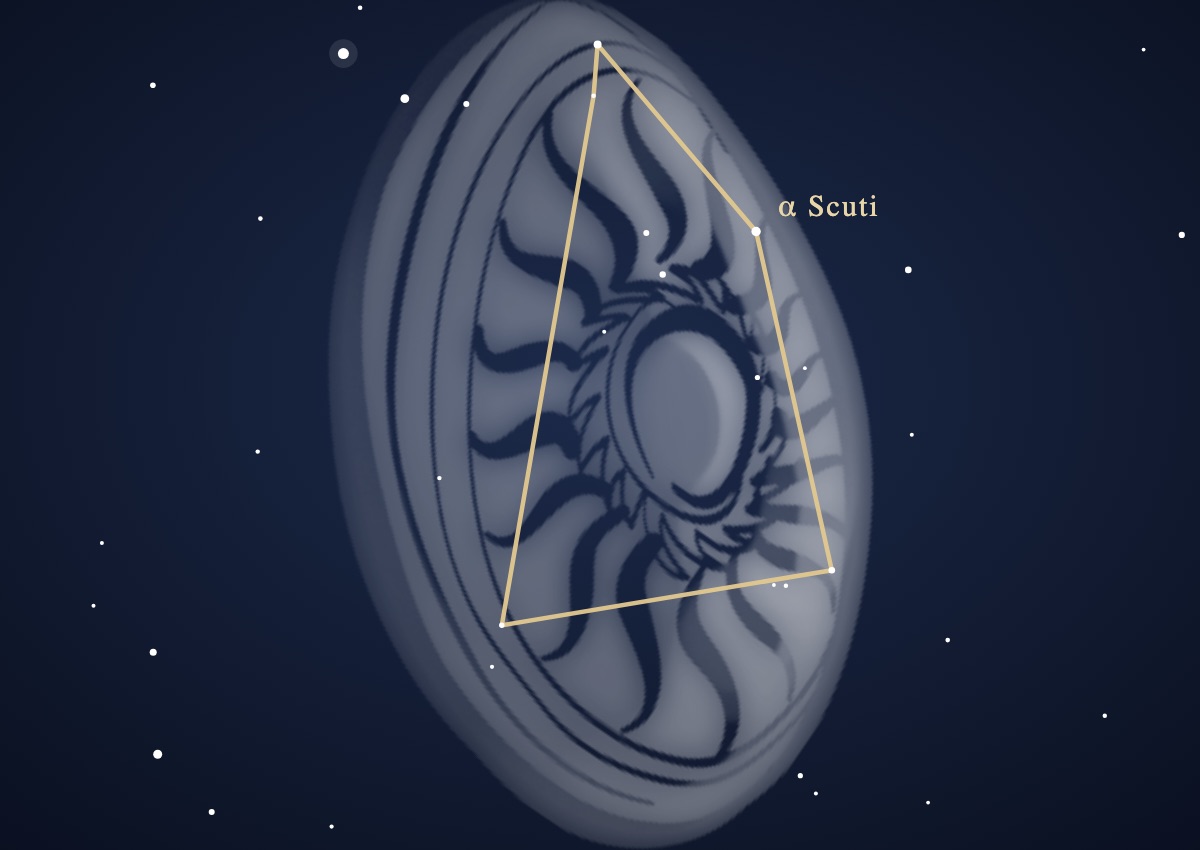
The constellation Scutum
Scutum (shield) is a constellation of the southern hemisphere. Its brightest star is α Scuti. It lies to the south-west of the twelfth brightest star in the sky, the star Altair in the constellation Aquila.
The constellation Scutum lies in the middle of the Milky Way and contains many open star clusters (groups of hundreds of stars). The best-known open star cluster in this constellation is M11, known as the Wild Duck Cluster. With a six-inch telescope, you can clearly see its V-shaped outline, with its bright leading star at the tip. In 1844, the British astronomer William Henry Smyth saw this formation as a “flock of wild ducks”. The cluster contains around 2,900 stars and is about 6,100 light years away.
History
The constellation was introduced by Johannes Hevelius (1611–1687), astronomer and founder of the mapping of the moon, in 1684 in the Leipzig scholarly journal “Acta Eruditorum” under the name “Scutum Sobiescianum” (Sobieski's shield). It was meant to honour King Jan III Sobieski of Poland and his strategic achievements in the fight of the Poles against the Ottoman Empire at the gates of Vienna (Battle of Kahlenberg, 12 September 1683). At that time, King Jan III Sobieski freed Vienna from a Turkish siege that had lasted two months. It is the only remaining constellation with a political background. However, it was only accepted as one of the 88 constellations in a non-political form. For this reason, the name of the constellation was shortened to “Scutum” (shield).