Fact sheet
- Latin name
- Coma Berenices (Com)
- Brightest star
- β Comae Berenices (β Com)
- Relative brightness
- 4.26 mag
- Hipparcos catalogue
- HIP 64394
- Area
- 387 deg² (rank: 42 out of 88)
- Right ascension
- 11h 58m 25s to 13h 36m 07s
- Declination
- +13° 18' 14'' to +33° 18' 27''
- Neighbouring constellations
- Canes Venatici, Ursa Major, Leo, Virgo, Boötes
Visibility
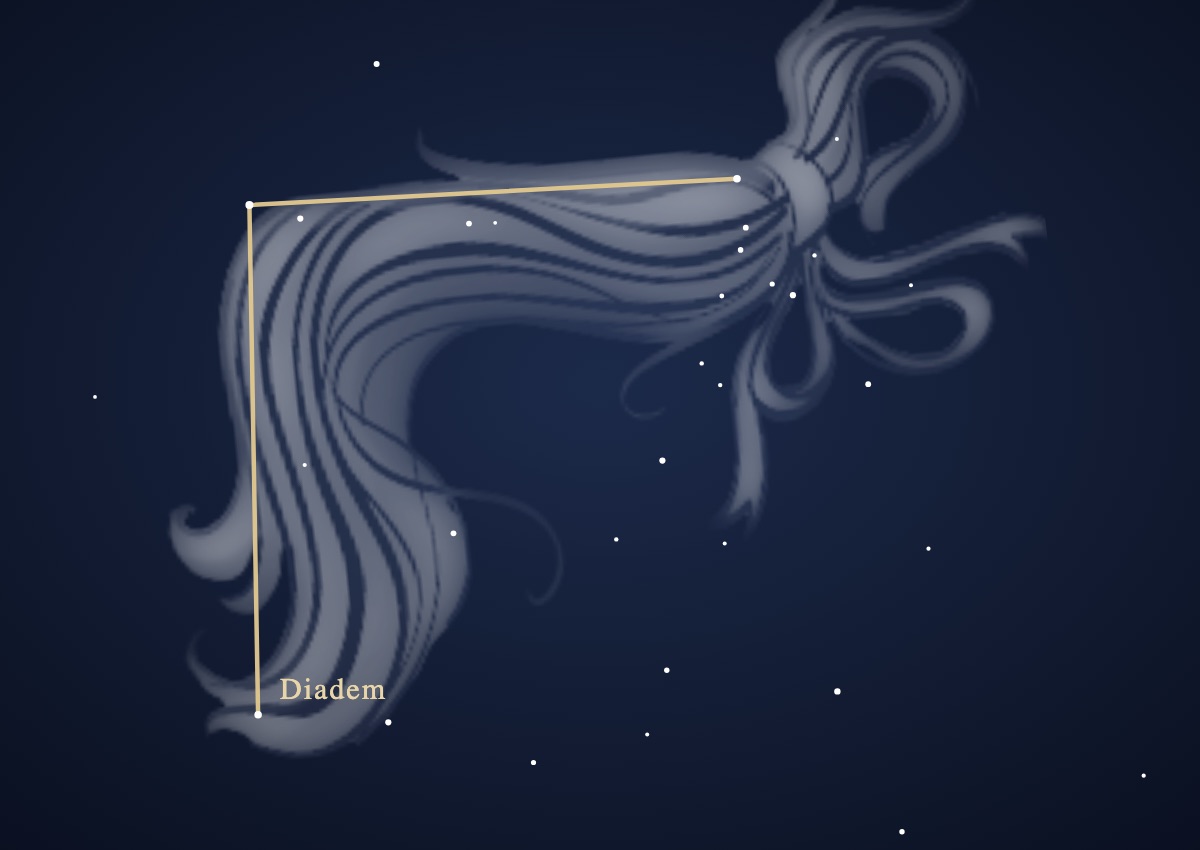
The constellation Coma Berenices
Coma Berenices is a constellation of the northern hemisphere. The brightest star of this constellation is β Comae Berenices. The star Diadem (α Com), whose name refers to the jewels in the hair of Queen Berenice of Egypt, is hardly any fainter. It represents the tip of the hair in the constellation.
Particularly worth mentioning are the Coma Star Cluster (Mel 111) and the Coma Galaxy Cluster (Abell 1656, Coma Cluster). Many stars of the constellation Coma Berenices belong to the Coma Star Cluster, which is about 280 light years away. This open cluster consists of 37 individual stars, and under ideal conditions it can be seen with the naked eye. The Coma Galaxy Cluster, on the other hand, is a huge group of more than 1,000 galaxies at a distance of about 320 million light years. Unfortunately, because of its distance, it can only be observed with a telescope.
History and mythology
In ancient Greece, this constellation was at first counted as part of the constellation Leo. It represented the tip of Leo's tail. It was first shown as a constellation in its own right by the German cartographer Caspar Vopel on his celestial globe in 1536; in 1551 the Dutch geographer and cartographer Gerhard Mercator (1512–1594) also included it on his celestial globe. When Tycho Brahe, a Danish astronomer, included the constellation in one of his works a little later, it was considered established.
Berenice was a queen of Egypt in the 3rd century BC. She was married to King Ptolemy III of Egypt, whose sister was also called Berenice. The king's sister was married to the Seleucid king Antiochus II. After her husband's death, she became involved in disputes over the throne, and her life was in danger. She therefore asked her brother, King Ptolemy III, to come to her aid with his army. Ptolemy III then went to war for his sister. Queen Berenice, who was very worried about her husband, promised the goddess Aphrodite (goddess of love, beauty and desire) that she would sacrifice her hair to her if only her husband returned healthy and victorious. Unfortunately, Ptolemy III was not able to save his sister, but he returned to Egypt victorious and healthy. Queen Berenice then kept her promise and placed her hair in a temple at Cape Zephyrium, near Alexandria. By the very next day, her hair had disappeared from the temple. At the same time, her court astronomer Conon of Samos observed many new stars rising east of the constellation Leo and north of the constellation Virgo. People therefore assumed that Aphrodite had found Berenice's hair so beautiful that she had immediately placed it in the sky.