Fact sheet
- Latin name
- Lyra (Lyr)
- Brightest star
- Vega (α Lyr)
- Relative brightness
- 0.03 mag
- Hipparcos catalogue
- HIP 91262
- Area
- 286 deg² (rank: 52 out of 88)
- Right ascension
- 18h 13m 52s to 19h 28m 29s
- Declination
- +25° 39' 51'' to +47° 42' 52''
- Neighbouring constellations
- Draco, Hercules, Vulpecula, Cygnus
Visibility
The constellation Lyra
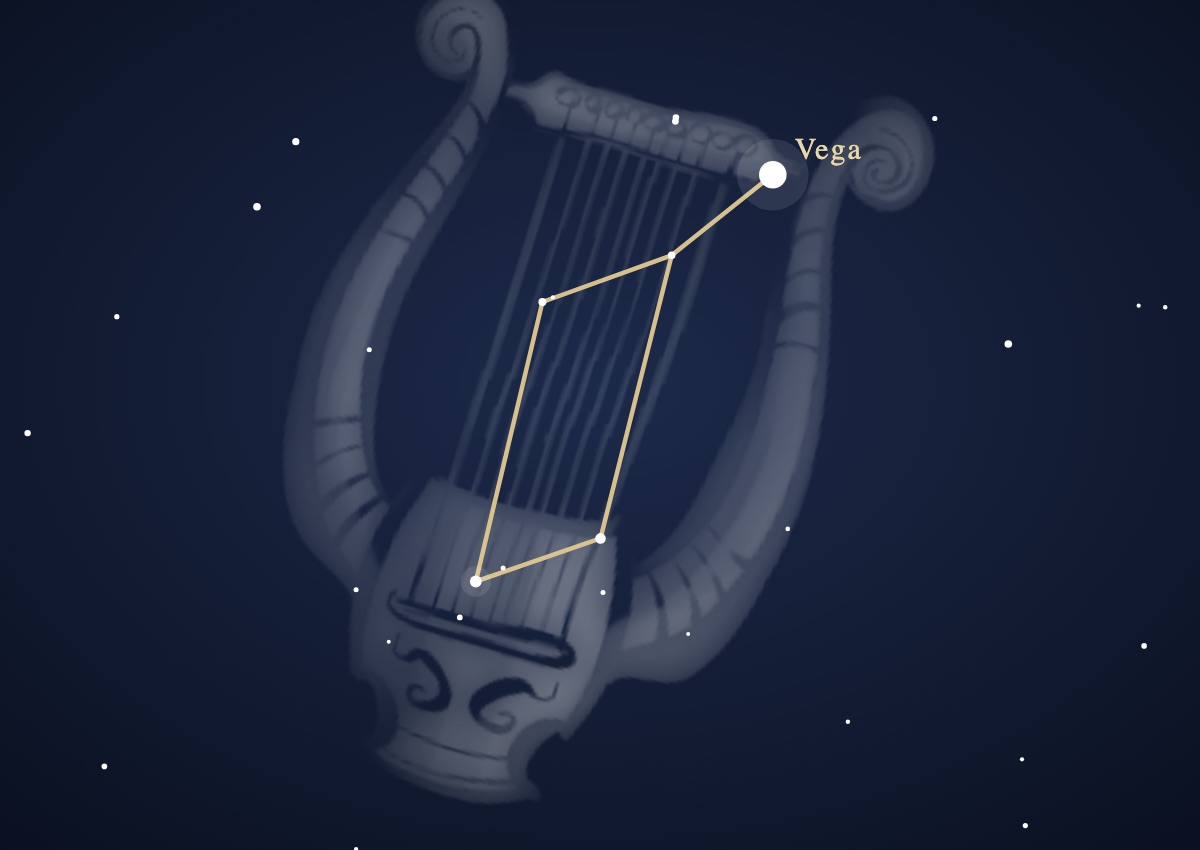
Lyra is a constellation of the northern hemisphere. Its brightest star, α Lyrae, bears the Arabic name Vega (swooping eagle), because the Arabs saw a bird of prey swooping down in the constellation. Vega is the fifth brightest star in the entire sky and, after Arcturus in Boötes, the second brightest star of the northern sky. Vega is also part of the famous Summer Triangle, a simple pattern in the northern sky formed by the brightest stars of the constellations Lyra (Vega), Aquila (Altair) and Cygnus (Deneb). Between β and γ Lyrae lies the Ring Nebula M 57, the best-known planetary nebula: the cast-off outer layers of a dying star.
Mythology
The constellation Lyra is linked to two legends. According to the first legend, it was the instrument of the singer Orpheus. This very first lyre was made by Hermes, a son of Zeus, from the shell of a tortoise. One day, Hermes had stolen the cattle of his half-brother Apollo for fun. Apollo only calmed down when Hermes offered him the lyre in exchange. It is said to have been Apollo who finally gave the lyre to Orpheus. Orpheus's bride Eurydice had died from a snake bite. With his playing, Orpheus softened the heart of Hades, the god of the underworld, and was allowed to lead his wife out of the underworld. However, Hades set the condition that Orpheus was not allowed to look back at her until he was on the surface of the Earth. So Orpheus led the spirit of his wife through the dark passages of the underworld, showing her the way with the sound of his lyre. He became more and more uncertain whether Eurydice was still following him. Having almost reached the top, he could not bear it any longer and looked back. At that moment Eurydice was pulled back into the underworld. Orpheus could not be comforted. From then on he wandered lost through the land and played only sad songs. Later, Thracian women, followers of Dionysus, tore him to pieces. The Muses buried him, and at their request Zeus placed his lyre in the sky. According to a more recent interpretation, it was the instrument of Arion of Lesbos, a great Greek singer and poet from the 7th century BC. On his journey home from a lucrative concert tour to Sicily, sailors wanted to kill him to get hold of his wealth. Arion was allowed to sing one last song, leapt into the sea and was carried back to Greece by a dolphin (the constellation Delphinus).