Fact sheet
- Latin name
- Columba (Col)
- Brightest star
- Phact (α Col)
- Relative brightness
- 2.65 mag
- Hipparcos catalogue
- HIP 26634
- Area
- 270 deg² (rank: 54 out of 88)
- Right ascension
- 5h 03m 54s to 6h 39m 37s
- Declination
- -43° 06' 42'' to -27° 04' 38''
- Neighbouring constellations
- Lepus, Caelum, Pictor, Puppis, Canis Major
Visibility
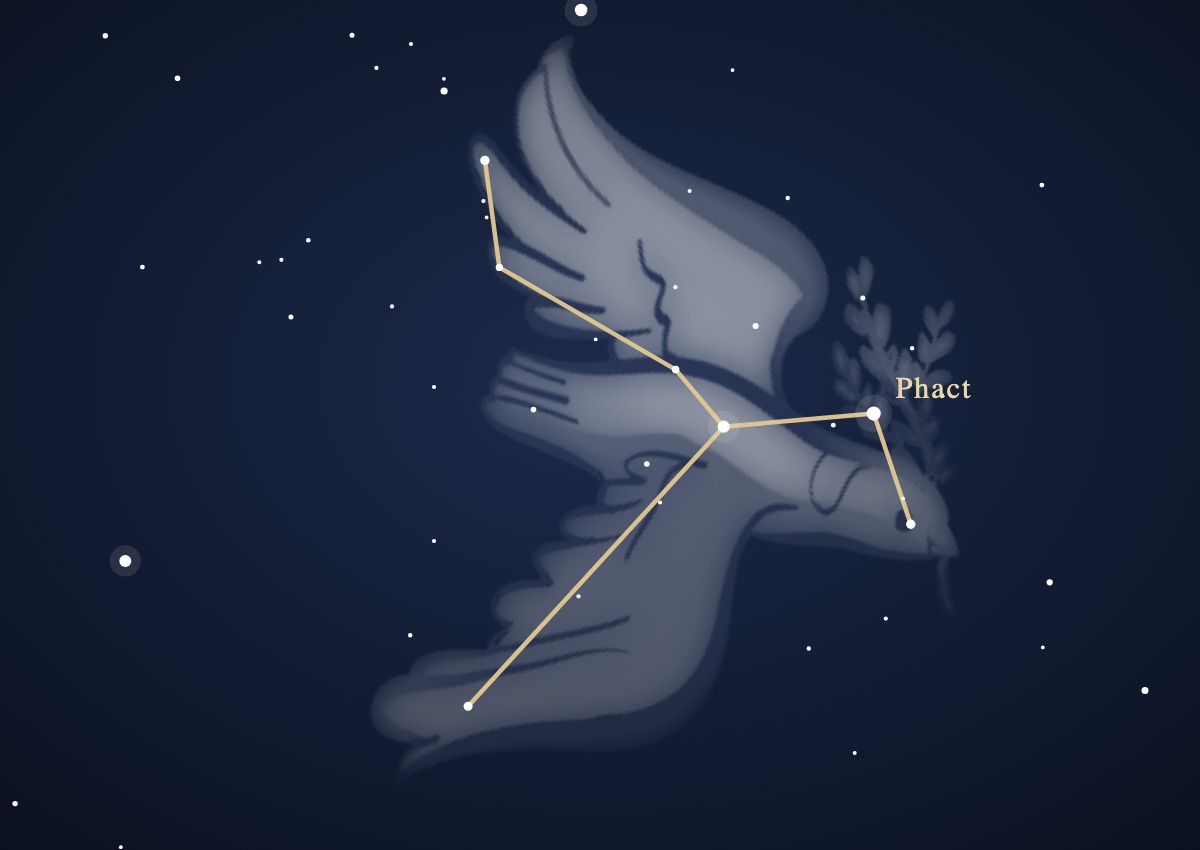
The constellation Columba
Columba is a constellation of the southern hemisphere. Its brightest star is α Columbae, which bears the Arabic name Phact (dove). The constellation lies west of the constellation Puppis. Columba seems to fly ahead of the ship Argo, which is made up of the constellations Carina, Vela and Puppis.
History
In 1612, the Dutch theologian, astronomer and cartographer Petrus Plancius designed a celestial globe that showed several new constellations which contained no bright stars.
The constellation Columba still goes back to him today. Its stars were already known to Ptolemy. However, he did not assign them to any constellation, but listed them as loose stars outside Canis Major. Plancius first showed it on a large world map in 1592. He probably named it after the dove that Noah sent out to look for land. One day this dove came back to the ark with a fresh olive branch in its beak. For Noah, this was the sign that the flood would soon be over, because plants were already growing on the earth again (after Gen 8:11).
On his celestial globe, he also reinterpreted the ancient constellation of the ship Argo as "Noah's Ark", and in 1627 Julius Schiller took up this idea in his Christian star atlas. However, the ship Argo prevailed. In the 18th century, it was then divided into three parts by Nicolas-Louis de Lacaille.
Mythology
However, the dove also appears in Greek mythology in connection with the ship Argo. In the legend of the Argonauts, it helps Jason and his companions, who are searching for the Golden Fleece, to pass through two floating rocks at the exit of the Bosporus. The two rocks crashed together as soon as a living being passed between them. The dove, however, managed to fly through before the closing rocks could catch it. The ship Argo then sailed at full speed and also made it through the rocks, which were moving apart again, before they crashed together once more.