Fact sheet
- Latin name
- Lynx (Lyn)
- Brightest star
- α Lyncis (α Lyn)
- Relative brightness
- 3.14 mag
- Hipparcos catalogue
- HIP 45860
- Area
- 545 deg² (rank: 28 out of 88)
- Right ascension
- 6h 16m 14s to 9h 42m 50s
- Declination
- +32° 58' 09'' to +61° 57' 51''
- Neighbouring constellations
- Camelopardalis, Auriga, Gemini, Cancer, Leo, Leo Minor, Ursa Major
Visibility
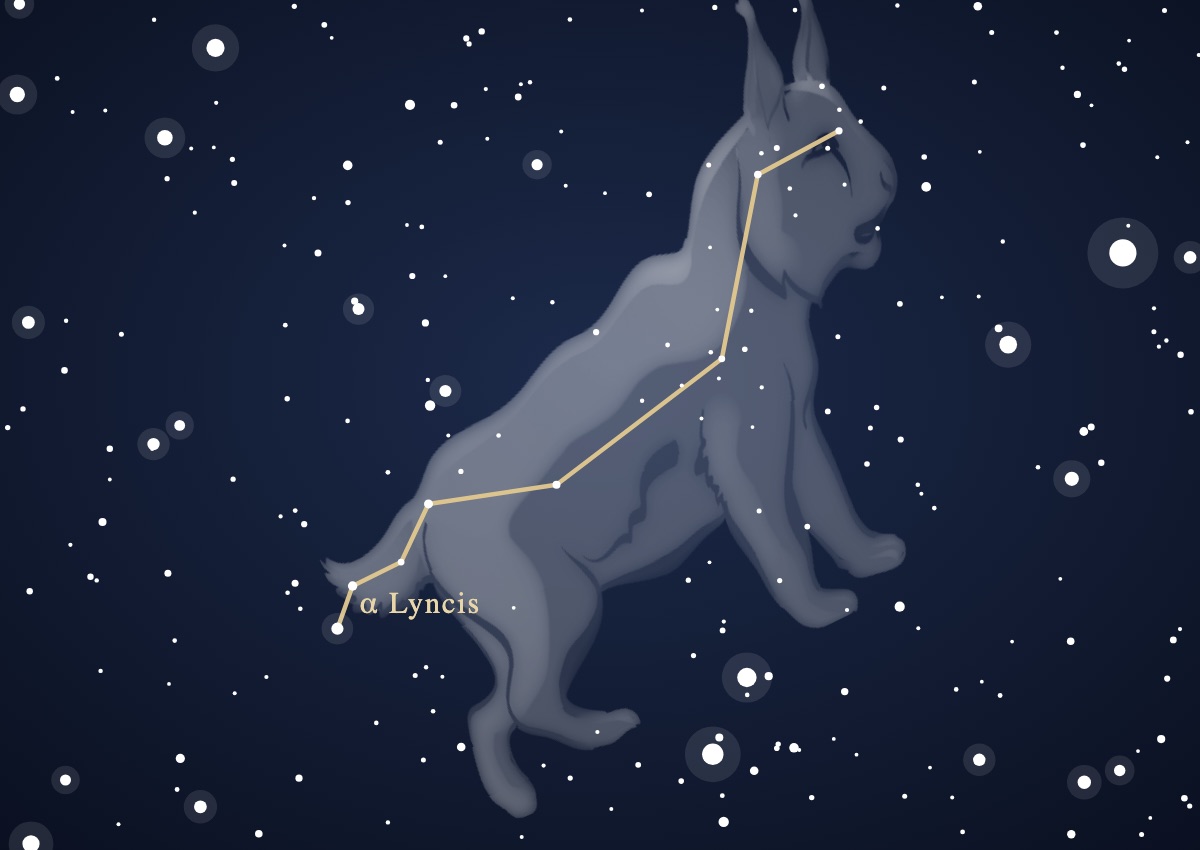
The constellation Lynx
Lynx is a constellation of the northern hemisphere. It is one of the least noticeable constellations in the night sky and is hard to find. The constellation lies between the constellations Leo Minor and Camelopardalis, which are also very faint, in a region with very dim stars. Only its brightest star, the star α Lyncis, has a Greek letter. All the other stars of this constellation are only identified by a catalogue number. Among stargazers there is a saying: where the naked eye sees nothing, that is where the constellation Lynx lies. The creator of this constellation, the astronomer Johannes Hevelius, already believed that only people with eyes as excellent as those of a lynx could recognise this constellation in the sky.
Mythology
Little is known about the mythology of the constellation Lynx. Hevelius may have been thinking of Lynceus, a son of Aphareus, king of Messenia. Lynceus is said to have had the sharpest eyes in the world. With them, he could see through walls and look under the ground. Together with his twin brother Idas, he accompanied the Argonauts (the myth of the ship Argo). Among the Argonauts were also their cousins, the twin brothers Castor and Pollux (the Dioscuri). When Castor got into a quarrel with his cousin Idas, it ended in Castor's death. He was killed by Idas in the fight. Full of anger about the death of his twin brother, Pollux then killed Idas's twin brother Lynceus. Before Idas, in turn, could take revenge, Zeus intervened and struck him down with a bolt of lightning. Pollux, who was immortal and had been very close to his twin brother, grieved deeply for Castor. In his pain, he asked Zeus to allow him to share his immortality with his twin brother. Zeus agreed, and from then on they spent their days alternately in Hades, the underworld, and on Olympus, the mountain of the gods. For their brotherly love, both were placed in the sky as the constellation Gemini. Their cousin Lynceus is represented in the sky by a lynx. To find him, however, you need the eyes of a lynx, exactly like the eyes he himself had.